

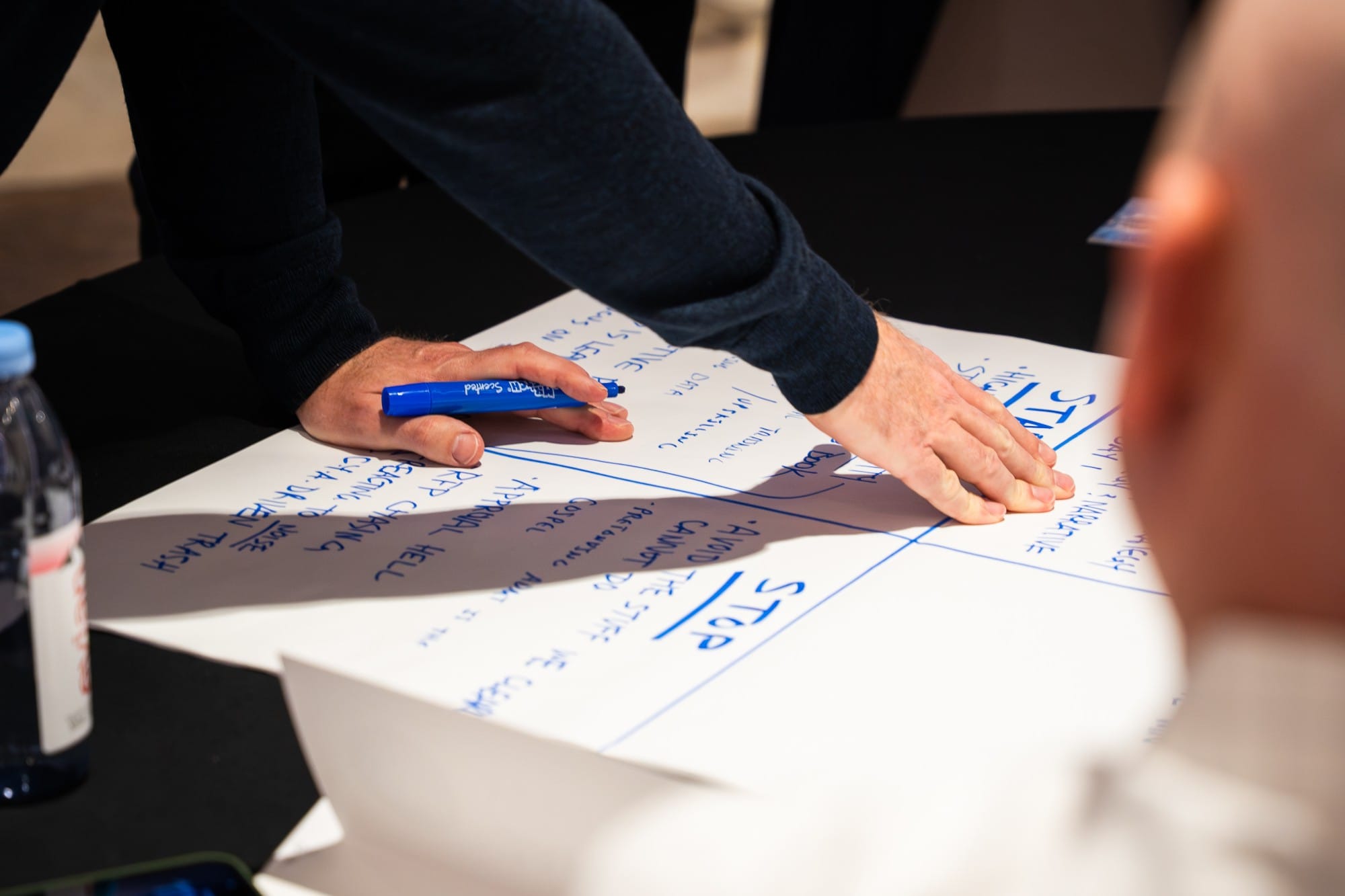
At a retreat this September, a leader leaned across a long wooden table and wrote her group's list on a poster with four columns: what works, what doesn't work, what to start and what to stop. Every line on a poster like that is a problem or a strength in how a team does its work.
That poster is where any good AI conversation starts too. The tool comes later.
Every company exists to serve a purpose
We start every engagement in the same place. A company exists to serve a purpose, and the leaders' job is to reach the outcomes that purpose requires. Everything else is a tool. Leadership is a tool. Culture is a tool. Technology, including AI, is a tool.
Tools are only as useful as the problem they solve. A hammer is a great purchase if you have nails.
The order matters
Most companies approach AI in the reverse order. A new tool arrives, someone runs a pilot, and the team goes looking for a place to use it. The result is a long list of pilots and a short list of results.
We work in this order instead:
- The outcome. What result does the business need in the next 12 months? Faster customer response, higher margin on a service line, fewer hours spent on reporting.
- The problems in the way. What specifically stands between us and that outcome? Name the work, who does it today and how long it takes.
- The tool. For each problem, what is the right tool? Sometimes it is AI. Sometimes it is a clearer decision right, a better meeting or a person in the right seat.
When AI is the right tool, this order also tells you how to measure it, because you already know what better looks like.
How to tell a problem is ready for AI
A problem is ready when you can answer three questions:
- What is the work, step by step, and who does it today?
- How much time, money or quality is lost in it now?
- What would better look like, in a number we could track?
If the team cannot answer those, the problem is not ready for AI yet. It is ready for a conversation.
Lead with the outcome
AI forward means using AI wherever it moves the outcome, and starting every conversation about it with the outcome itself. If you want help finding the problems worth solving first, start with the AI Readiness Check or read about AI and leadership.
Frequently asked questions
How should a company decide where to use AI?
Start with the outcome the business needs, name the specific problems in the way, then choose the right tool for each problem. AI is one of those tools, alongside leadership, culture and process changes.
How do you know if a problem is a good fit for AI?
When you can describe the work step by step, who does it today, what it costs now and what better would look like in a number you can track.
Why do so many AI pilots fail to deliver results?
They start with the tool and go looking for a use. Pilots that start from a defined outcome and a measured problem know what success looks like before they begin.
Related service: AI and leadership